Inside McLaren’s 'Designed to Race' fashion show – How 46 designers reimagined six decades of racing history
James Hunt’s rebellious style, Ayrton Senna’s iconic yellow helmet and the modern Papaya era all shaped McLaren’s 12-look runway collection in collaboration with Central Saint Martins
.png)
.webp)
On Wednesday evening, the McLaren Technology Centre looked markedly different having been transformed into a fashion runway.
Instead of team personnel, it was models walking between some of McLaren's most famous cars that took centre stage, wearing a very different interpretation of the team’s history.
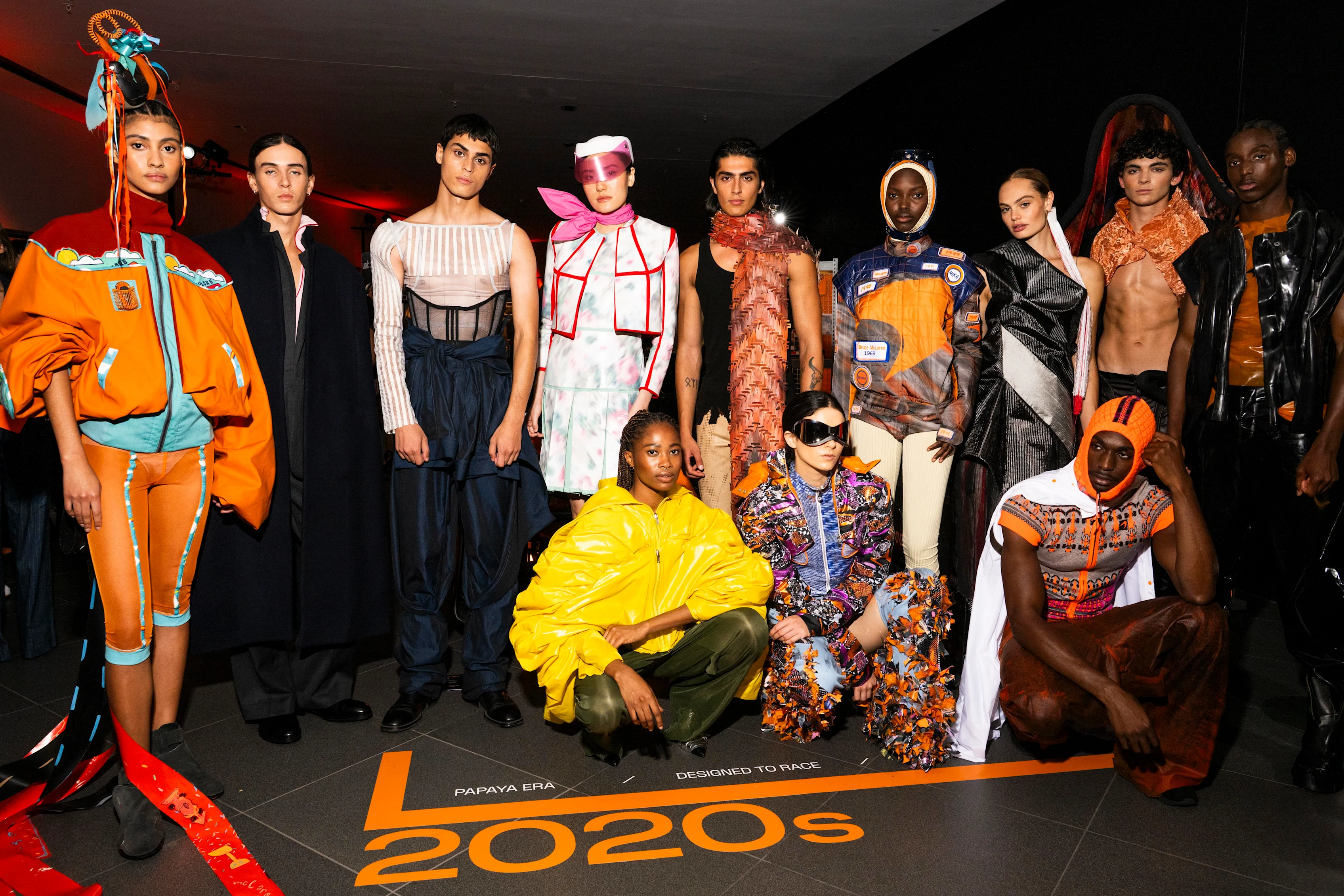
This was Designed to Race: Front Row, a show where 46 MA fashion students from Central Saint Martins presented 12 looks inspired by more than six decades of McLaren history.
James Hunt’s approach to racewear was one of the clearest references in the collection. So was the yellow of Ayrton Senna’s helmet, old racing equipment, engineering drawings and, much later in the collection, the papaya-clad fan culture surrounding the team today.
However, unlike many fashion collaborations, the students were not designing something for McLaren to sell.
“I think this was really about opening up a conversation,” McLaren Racing Chief Marketing Officer Louise McEwen exclusively told F1.com after the show. “The more we worked together, the more we realised, although we are in different spheres and different businesses, how similar we were.
“Both are incredible high-performing teams coming together with incredible craft, creativity and ingenuity at the heart of everything that we do. So it’s been a brilliant journey with them over the last nine months or so, coming up with the collections and working with the team there.”
The students had been split into 12 groups and handed a wide brief. A driver or famous car could be the starting point, but so could a period in McLaren’s history, the engineering behind the team or the people around it.
The finished collection moved through five chapters: Grit x Glamour, Precision and Power, Global Icon, Engineered Athlete and Papaya Era.
From the 1970s to Senna
The collection begins with the 1970s, when McLaren were establishing themselves as one of Formula 1’s leading teams.
Emerson Fittipaldi delivered McLaren’s first Drivers’ Championship in 1974, the same year they won their first Constructors’ Championship. Away from the results, F1 was changing too. Television audiences were growing and drivers were becoming increasingly recognisable away from the track.
James Hunt arrived at McLaren shortly afterwards and his unique style gave the students plenty to work with.
His habit of wearing his overalls tied around his waist, his disregard for formal dress and his wider image fed into Grit x Glamour. Flared silhouettes, leather, orange tones and distressed finishes all appeared, taking elements of Hunt’s style without simply recreating his wardrobe.
Speaking during a panel discussion ahead of the show, Central Saint Martins MA Fashion Course Leader Fabio Piras explained that the brief deliberately left room for that kind of interpretation.
“The brief was interesting because it wasn’t asking us to necessarily design a piece of fashion, an outfit," he said. "It was an interpretation of a period, of an era, of a character, of obviously an iconic champion and a car.
“I think the visit of the students to the Technology Centre was an absolutely bombastic moment for them, because actually you don’t realise how fantastic those cars are if you don’t see them closely, even in terms of design objects. They’re amazing design objects.”
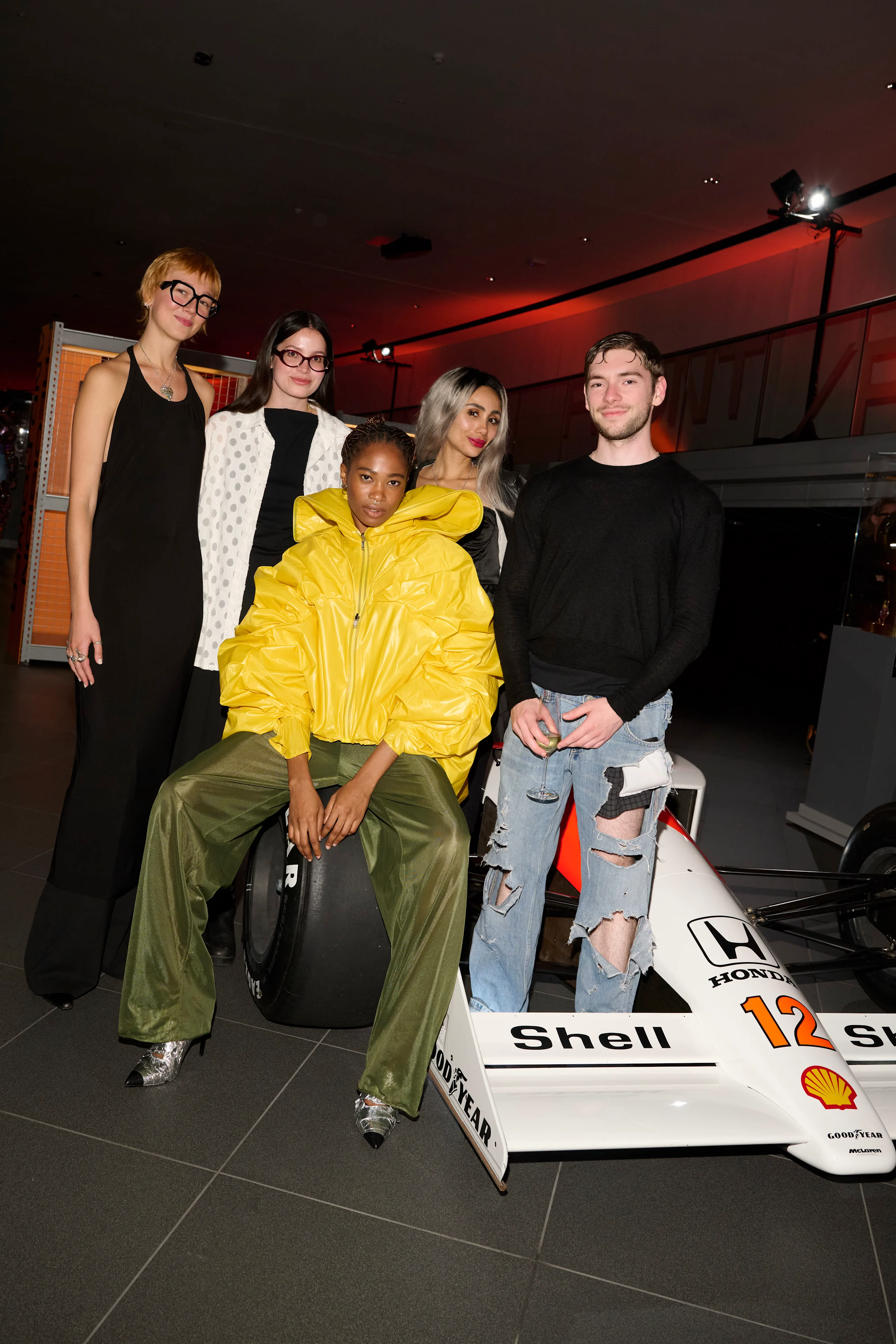
For MA Fashion student Enzo Keuning, that freedom was what made the project interesting.
“What made this project unique was that there wasn’t one way to interpret that heritage. Each group brought a different perspective, from engineering and performance, to identity and craftsmanship, and we were challenged to transform those ideas into something new.
“My background in econometrics has taught me to look at systems through patterns, relationships and connections, so I found it fascinating to approach McLaren’s history through fashion.”
As the collection moved through McLaren’s history, some of the references became more technical. Senna’s famous yellow helmet was one of the clearest, but the students also looked at his precise driving style and the idea of speed. The resulting pieces used lightweight fabrics, shapes informed by airflow and digitally developed patterns.
Other groups looked away from the driver completely. One design centred on a female fire marshal, while track layouts, old team graphics and pieces of racing equipment appeared in smaller details throughout the collection.
Sometimes you had to look twice. Monaco’s famous hairpin, for example, was stitched inside a pair of trousers.
The details behind the clothes
Getting those 12 looks to the runway took months.
Fashion, Piras told the panel, is usually seen at the point where the work is already done. The audience gets the runway, but not the months of changing ideas, criticism and mistakes that came before it.
“When we see fashion, we always see the outcome. We see the 10-minute performance at the end. That’s the length of a fashion show.
“What an audience doesn’t have access to is the time it takes to get to those 10 outfits, in this case 12. The process of fashion is trial and error.
"You build the narrative, you build the information that will inform your fashion, but then it’s about trying things out and moving on with the mistakes. That’s how you create fashion.”
Piras’ description of trial and error was familiar territory for McLaren too, even if the measurements involved look very different.
During the panel, McEwen recalled how small the margins can become, using a request to save weight ahead of the 2025 British Grand Prix as an example.
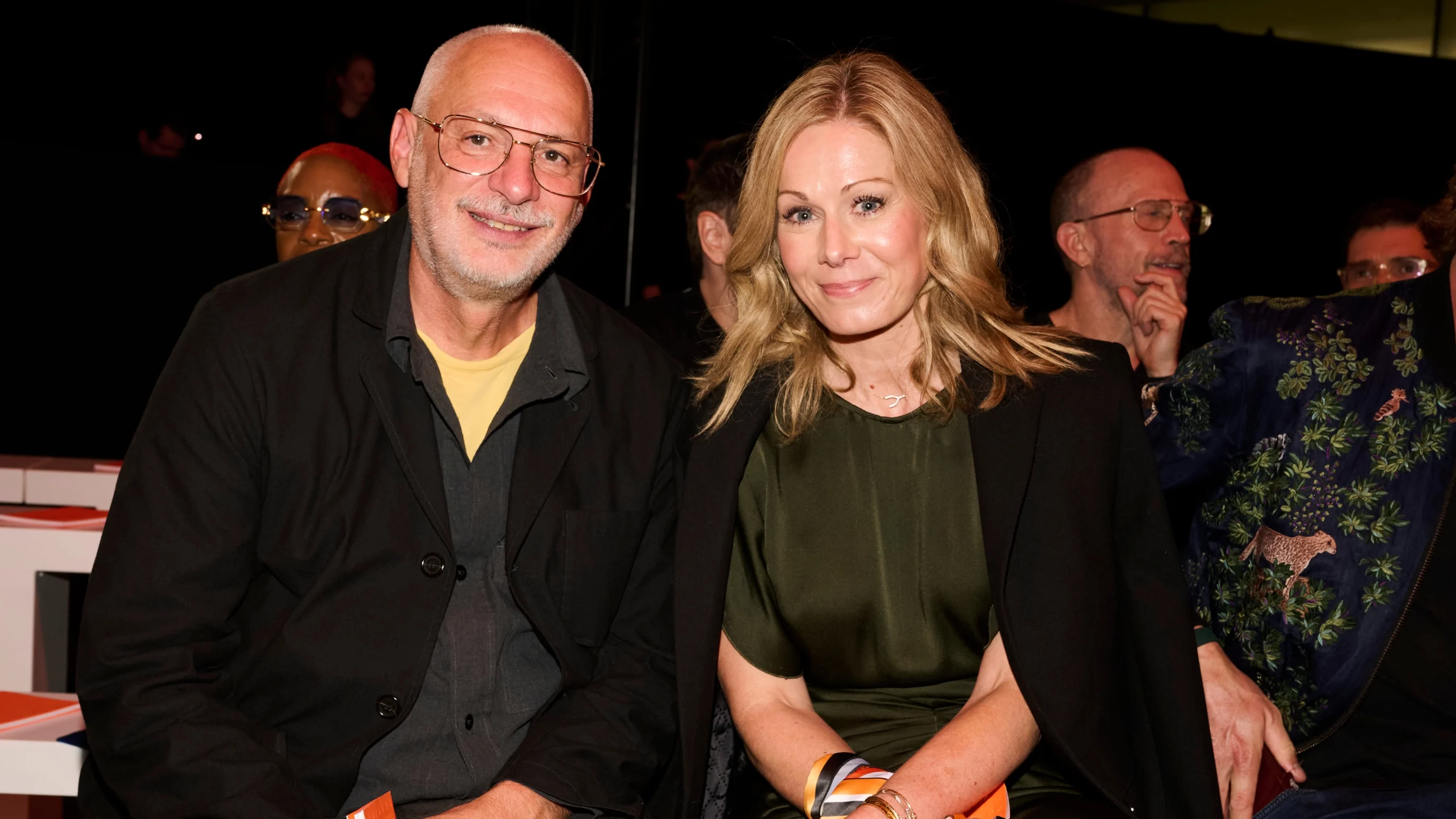
“As a team, we’re in a constant state, similarly to Central Saint Martins, of reinvention. We have a saying that we absolutely can’t stand still because we have to keep innovating to stay at the front of the grid. If we don’t, we’re definitely going backwards.
“Even at the front, it boils down to microns and milliseconds that can make the difference between those grid positions for us.
“Last year, going into the British Grand Prix, our Team Principal said, ‘Lou, we need to save weight,’ and I can’t tell you how much, but it’s fair to say it was some segments of papaya that really make the difference. That’s the precision and detailing, and I think it was really evident working through the design process how much of that came through in the students’ designs.”
Engineering blueprints and aerodynamic forms fed into patterns and silhouettes, while carbon fibre and upcycled racing seatbelts were brought into the collection itself, with fabric offcuts, second-hand materials and used McLaren equipment also appearing across the 12 looks.
The Papaya era
Jump forward five decades and the references become perhaps easier to recognise.
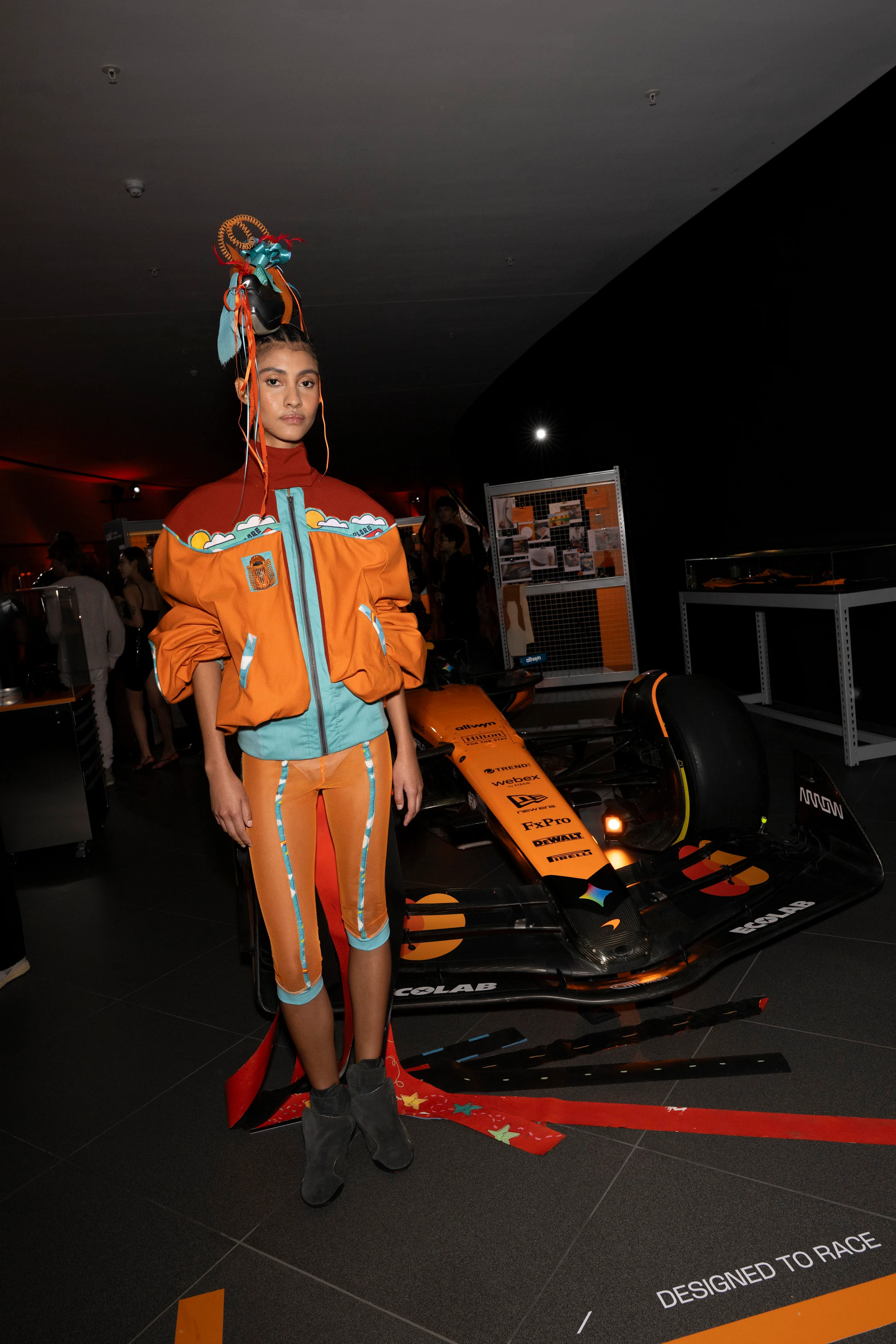
Papaya dominates, racewear is mixed with denim and knitwear, and even Daniel Ricciardo’s ‘Shoey’ makes an appearance as a headpiece.
The final chapter looked at the current McLaren era and the audience surrounding it. One group played with the idea of young fans seeing drivers as heroes, using toy cars, childlike drawings and a cape-like silhouette, while used McLaren racing boots from previous eras were brought back for the finished look.
The way fans interact with Formula 1 now was one of the reasons McLaren wanted to do the project in the first place.
During the panel, F1 Presenter Ariana Bravo spoke about just how much the audience around the sport has changed.
“Formula 1 has seen a growth in its audience in a way that I don’t think any of us within the sport were expecting," she said. "It’s a much younger and a much more diverse audience now.
“With that comes a different way that people want to consume our sport. It’s not just about watching the cars go around on track anymore. It’s about everything that surrounds that as well.
“Yes, of course, they’re fans of the racing first and foremost, but they also want to tap into the culture. They want to tap into the lifestyle aspect of it. They don’t want to just tap into the drivers in race mode. They want to have this accessibility 24/7, and they want to be able to express their support for a team through fashion, through culture.”
McEwen told F1.com that Global F1 Fan data shows nearly half of fans consider fashion important to the way they express their fandom. That data helped inform the project, although McEwen says success cannot simply be measured in reach or engagement.
“We are obsessed by data, and the whole piece tonight was informed by data," she said. "The fact that our fans, and half of F1 fans broadly, actually say that fashion is important to them and it’s how they show their fandom.
“But everything that you saw today was very much about creativity and humanness coming through.
“In terms of measurement, I think it’s a blend. It’s not one or the other. Tonight we opened the doors to the McLaren Technology Centre to many in the media who had never been here before, probably seeing a different side of us and our sport.
“Hopefully that will reach many new fans who might have been thinking about Formula 1, might not know anything about Formula 1, but might be fashion lovers, and vice versa. I think it’s just about that crossover between popular culture and sport that we’re seeing so much of right now.”
That changing audience was visible off the runway too, with guests from across motorsport, fashion, music and sport inside the McLaren Technology Centre for the show.
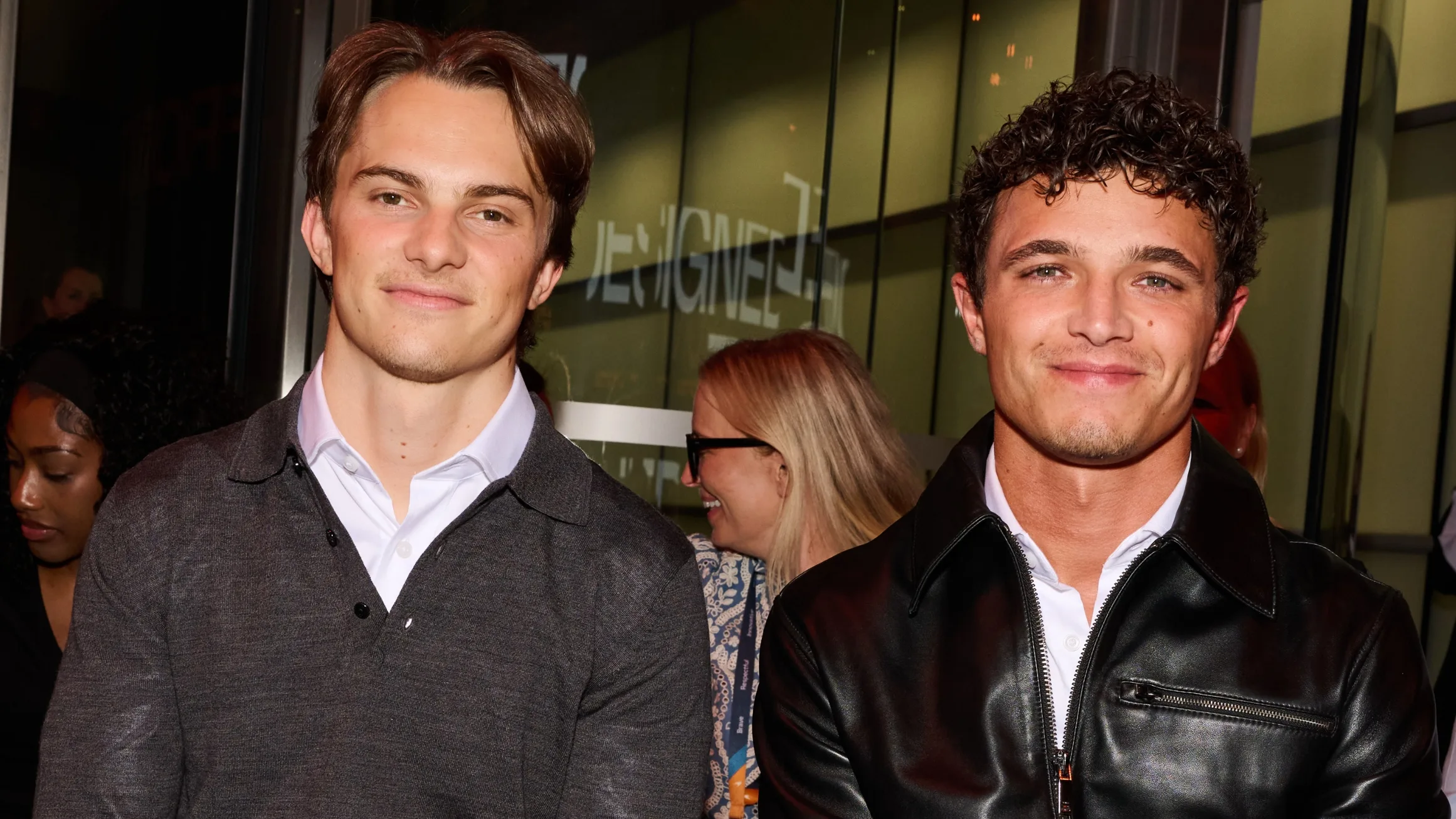
McLaren team mates Lando Norris and Oscar Piastri were joined by F1 ACADEMY drivers Ella Lloyd and Ella Stevens, as well as Freddie Hunt, son of James.
But also in attendance were models Mia Regan, Amechi Madu and Denola Gray, rapper Kojey Radical and Olympic medallist Amy Hunt.
McLaren are far from alone in embracing fashion, but McEwen is wary of suggesting any team can assume they have already worked out what this newer audience wants.
“I think in this game, you can never think you’re ahead of the curve, right?" she added. "There’s always someone just behind you waiting to catch up.
“I like to think that, as a team, we’ve really driven innovation in this space. Tonight again, I think we’ve shown another side of us. Showing up in a space where performance meets culture with that authenticity has been really important to us, and establishing a relationship with Central Saint Martins.”
For McEwen, giving creatives the freedom to interpret McLaren in their own way was also central to the project, and something she believes is just as important away from the track.
“We have to be as competitive off the grid as we are on it, and I think the point is, without creativity, we’re never going to appeal to new fans, we’re never going to have new ideas, and I think you’ve got to be really careful not to stifle that creativity.
“Tonight, you can see what can happen when you give people a little bit of inspiration, but then give them that scope to go and design and see where they want to go.
“I didn’t know quite what we were going to get tonight, and I’m just blown away and super excited.”
Next Up
Related Articles
 Why Williams' FW48 upgrade package in Baku is so crucial
 Inside the Italian dinner party staged on Monza's grid
 The power unit manufacturers with the most wins in F1 history
/Tsunoda%20header.webp) Tsunoda reveals his biggest mistake at Red Bull in 2025
Tsunoda reveals his biggest mistake at Red Bull in 2025 Who impressed our Power Rankings judges in Madrid?
 Formula 1 reveals calendar for 2027 season