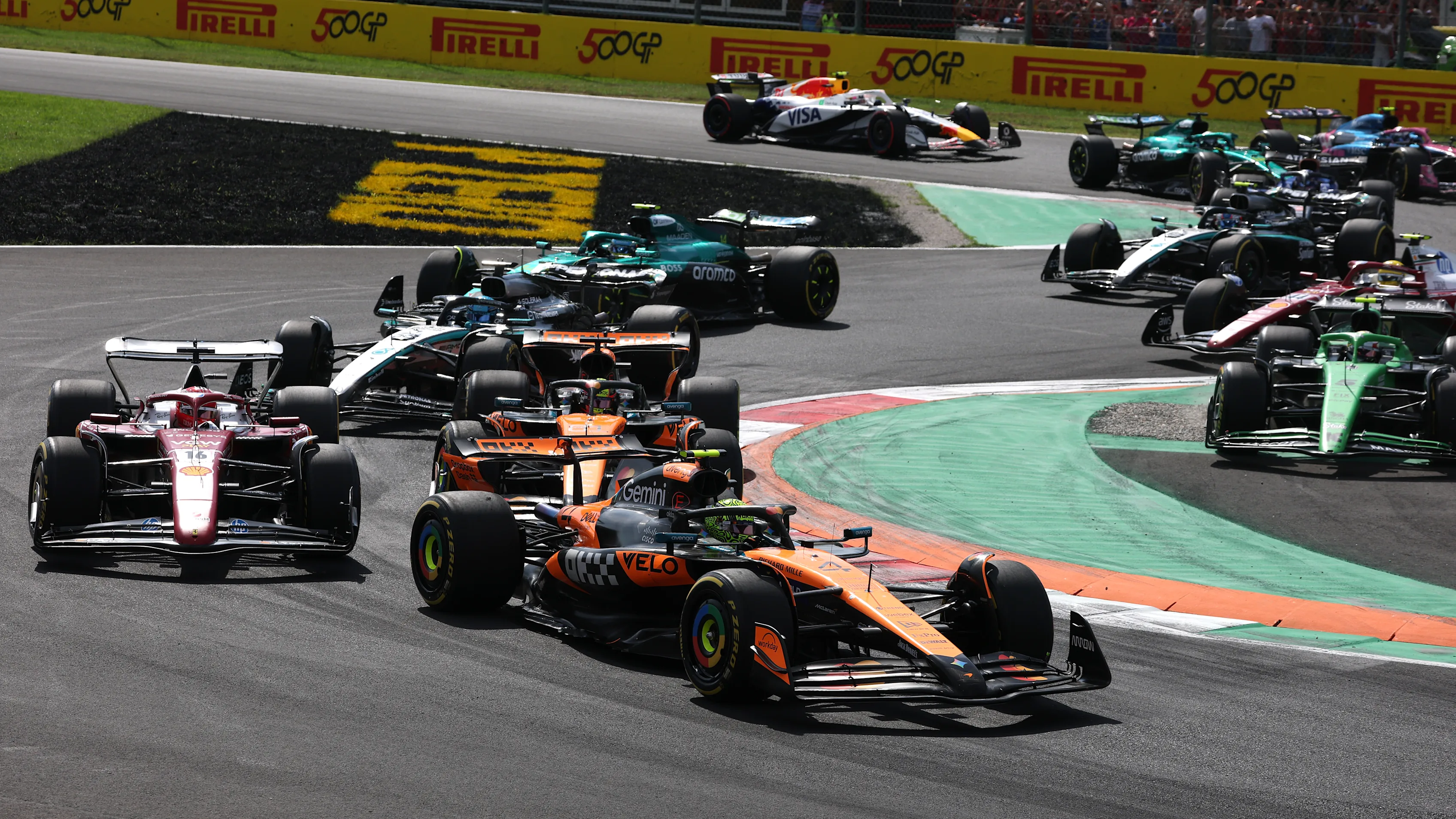
As the oldest circuit on the F1 calendar, the Autodromo Nazionale Monza holds decades of memories – but how well do you know the history of its corner names? Let’s take a look at the origins of each one…
Turns 1/2 – Prima Variante
The Temple of Speed was first constructed in 1922 and has undergone several changes, primarily to improve safety. Prima Variante, which has a no-nonsense translation of ‘first chicane’, was added when the circuit underwent refurbishment in 1972 to reduce the intensely high speeds.
It was previously known as the Variante del Rettifilo, roughly meaning ‘chicane of the straight’ as it was located in the middle of the original start/finish straight, but this title was shed for good when the turn was reprofiled again in 2000.
Turn 3 – Biassono
This sweeping right-hander used to be called Curva Grande (‘great curve’) due to its shape, but the aforementioned alterations in the early 1970s led to its new identity of Biassono, sharing its name with a local town.
Turns 4/5 – Seconda Variante
Next up is another aptly-named sequence of turns called Seconda Variante, or ‘second chicane’, that was created in further modifications made in 1976 to lessen the danger of the track – the extra run-off areas here are another indication of that goal.
This is a site of high drama, such as the 1995 collision between championship rivals Damon Hill and Michael Schumacher, but offers a fantastic spot for overtaking. It’s also sometimes referred to as Curva della Roggia after a nearby stream.
Turns 6/7 – Lesmo 1 & 2
Born the Curva della Querce (‘curve of the oaks’) due to the forest that envelops the circuit, this pair of right-handers were renamed Lesmo 1 and 2 for another local town. There are additional theories that its origin traces back to a family that lived in the region, or has a connection to the Greek island of Lesbos.
In years gone by, Lesmo 2 – formerly labelled Curva dei 100 Metri (‘100 metre curve’) for the short distance that separated the entry point from the exit, and the Curva del bosco dei Cervi (‘curve of the deer forest’) – was remarkably fast, with only the most courageous entering the turn at speeds of up to 300kph.
More adjustments in 1994 meant that its rapid nature was somewhat subdued, but it’s still a crucial spot for drivers hoping to set up an overtake at the next corner.
Turns 8/9/10 – Variante Ascari
After a very slight left-hand bend known as the Curva del Serraglio, which isn’t an official corner but commemorates a royal hunting lodge that stood close by, the straight leads into the final chicane called Variante Ascari.
It remembers Italian racing legend Alberto Ascari, a two-time World Champion who was tragically killed in an accident at the Monza Circuit in 1955. Prior to the dedication, the series of corners was named Curva del Platano (‘plane tree curve’) or Curva del Vialone (‘avenue curve') because it passed over the large access road to the track.
Turn 11 – Curva Alboreto
Last but by no means least is Curva Alboreto, still often called Parabolica – the 180 degree right-hander that looks like a mathematical curve called a parabola. It’s seen plenty of memorable moments and carries a fearsome reputation as a result, with bravery and commitment once again being key here.
A few years ago, the turn was renamed Curva Alboreto after former driver Michele Alboreto, who competed in F1 between 1981 and 1994.
Next Up
Related Articles
 BettingWhy F1 fans should avoid emotional bets in Austin
 Verstappen baffled after missing out on Austin pole
 Palmowski crowned 2026 champion as Larsen takes maiden victory
 BettingOur final predictions and latest United States GP odds
.webp) Freddie Hunt on his father James’ ‘incredible’ 1976 title
Freddie Hunt on his father James’ ‘incredible’ 1976 title Russell reflects on Austin Qualifying struggles